

Oud
Independence gave us, the Turkmen people, the opportunity to re-learn our immortal history, rewrite it, clarify its unknown pages, and restore our glorious past. Our lost musical instruments were also restored. One of our restored musical instruments is the oud.
The oud is the oldest fretless, plectrum-played musical instrument, which is widespread in the Middle East, the Caucasus, Central Asia, mainly in Turkmenistan, Armenia, Azerbaijan, Uzbekistan, Tajikistan, Iran, Turkey, Syria, Greece, and Egypt. The sound of the oud is soft, velvety, and has a slightly deeper and more melodious sound. For many centuries, the oud was used with five strings. The modern oud consists of six strings, and its strings are made of nylon. Its 1st, 2nd, 3rd, 4th, and 5th strings are double, and the 6th is single. Each pair of oud strings is of the same thickness, and the two strings are arranged in unison and are seen as one string. This musical instrument can play from two to six notes.
In ancient times, the oud musical instrument was considered the leader of other musical instruments due to its beauty and perfection of performance capabilities. In ancient Arab sources, the homeland of the oud is considered to be Saudi Arabia. The Arabs did not glue the oud's body with glue, but made the cover of the oud from wood and made it larger. There is an opinion that the Arabs were the reason for giving this musical instrument the name oud. The reason is that "oud" is an Arabic word and means "tree". As is known from historical sources, in the 3rd-7th centuries, the name of this musical instrument in Iran was barbat. It has two interpretations as follows:
1. Barbat - formed from the Arabic words "bar" and "bat", meaning "duck-like". Indeed, when viewed from the back, the oud resembles a duck with a short neck and a protruding chest.
2. It is associated with the name of Barbad Merzevi, a master of the oud in Eastern countries. In the poem "Shanam" by the great poet of the East, Firdausi, it is described in poetic verses that Barbad Merzevi participated in a competition of famous musicians held at the palace of the Iranian king Khosrow and won. After that, Khosrow appointed him as a musician of his court. Barbad Merzevi created more than 360 songs and made a great contribution to the development of Eastern musical culture.
The first image of the oud was found in the Qasr al-Khair al-Gharbi fortress near the city of Homs in Syria. This fortress was built in 727 and then fell into ruin over time. Only the ruins of this fortress have survived to our time.
This musical instrument was originally four-stringed. This is evidenced by the discovery of an ancient oud with four strings during archaeological excavations in Yemen. According to the Arab philosopher Abu Yaqub al-Kindi, those four introductions represented the four seasons and four basic elements. However, ancient sources also state that there were three, eight, and ten-stringed versions of the oud. The ancient oud had 9-12 strings tied from the intestines, and the strings were woven from silk thread and made of sheep's intestines. The great scholar of the Middle Ages, our compatriot Abu Nasr al-Farabi, was a master performer of the oud musical instrument. He introduced several changes to this musical instrument. Reliable sources say that it was Farabi who added a fifth string to this musical instrument. He devoted a part of his famous book "The Science of Music" to the methods of playing the oud, and wrote the first textbook. When the Arabs invaded Europe in the 8th century, they brought the guitar and several other musical instruments to Spain along with the oud. The oud that reached Spain was later called "laud" (la-ud) and gained great fame. Thus, this musical instrument spread to Italy, France, Germany, and several other European countries. In Europe, the lute musical instrument was created on the basis of this instrument. The lute was slightly modified, and instead of the gut frets, they were replaced with metal wire frets, and later with metal frets. In addition, the Arab oud is similar to the Chinese pipa, the Japanese biwa, and the Vietnamese tiba musical instruments.
During the time of al-Farabi, the frets on the oud strings were removed at the end of the 10th century, and five-stringed fretless ouds began to appear. Each of these strings had its own name. They were al-bam (lower string), al-maslas (third string), al-asma (second string), az-zir (upper string) and al-mutlak (fifth string).
The oud was the main instrument of Eastern classical music until the 17th century. Therefore, Darwish Ali Chang called it “the king of all musical instruments.” The first to use it as an instrument for singing was Saif Hasir, who lived in Al-Madinah in the first century of the Hijri. He introduced Persian sounds into Arabic poetry. In addition, in classical Persian poetry, this musical instrument was also praised by Nizam Genjevi in his works.
The oud consists of three parts in terms of structure: a pear-shaped gourd, a handle, and a headstock. In ancient times, the oud musical instrument was made from a large gourd, the size of a pear. To make this instrument, the gourd was cut in two, cleaned of seeds, properly hollowed out, and then dried. A handle was attached to the finished gourd. The modern oud's gourd is made of glued wooden ribs. The gourd of this instrument is made of pear, walnut, mahogany (red wood), sandalwood, and poplar, and the handle and ears are made of ebony. In general, when we talk about the structure of the oud, it consists of parts such as a gourd, lid, handle, ears, strings, upper and lower ribs, and sound holes. This depends on the wood chosen for the sound of the instrument.
When playing the oud, there is an ancient tradition of holding it. The oud is placed on the right leg and held in the armpit with the right hand. The wrist of the right hand is held on the strings, extending forward from the ass, ready to be plucked. The middle point of the oud is found where it connects to the leg, and it is placed on the leg. The fingers of the left hand rest on the handle and are held in a bent position so as to press the strings. The handle is mainly located between the thumb and other fingers.
In Turkmenistan, the oud is tuned to a perfect quarter interval The notes of the oud are written in the left (violin) key, and the written notes sound one octave lower. Its sound range (diapason) reaches from the C-sharp sound of the big octave to the A sound of the 1st octave. Since the sound range of this musical instrument is about 3 octaves, there are wide opportunities for performing our folk music.
As we mentioned at the beginning, the oud is one of the ancient lost musical instruments of the Turkmen people. After Turkmenistan became an independent state, our lost musical instruments were restored. Along with other musical instruments, the oud was first taught as a profession at the special music boarding school at the Maya Kuliyeva Turkmen National Conservatory. Later, the oud profession was taught in specialized and children's music and art schools, as well as at the Maya Kuliyeva Turkmen National Conservatory. Thus, for the first time during the years of independence, the oud profession began to be taught to students.
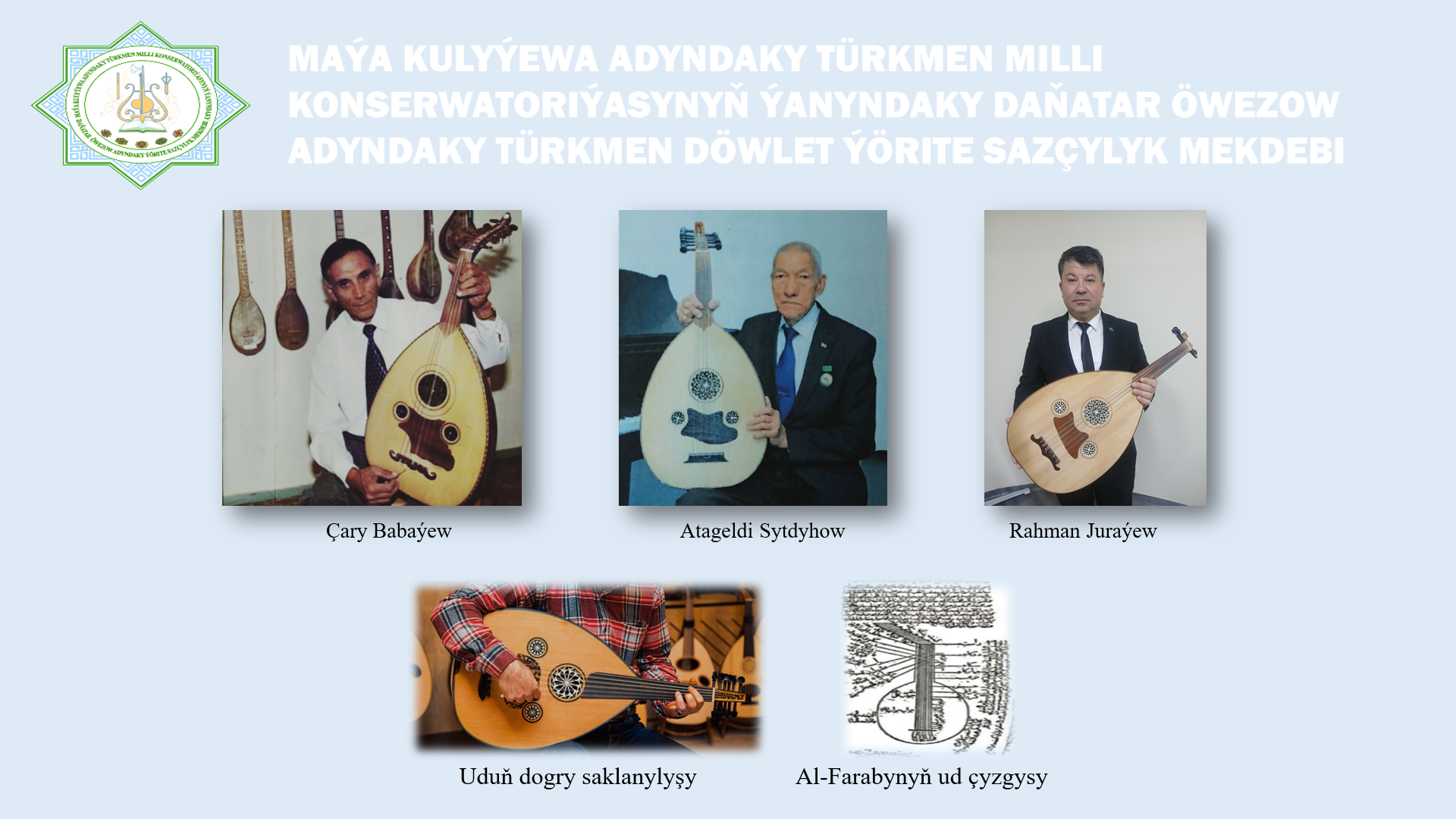
The great merit of the master musician, composer, and teacher Chary Babayev in the introduction of the oud profession in music and art schools, as well as in our national conservatory, is great. Chary Babayev first became acquainted with this musical instrument during his studies at the Muhtar Ashrafi State Conservatory in Tashkent in 1969-1974. He dreams of introducing many types of folk musical instruments, including the oud, into musical practice in Turkmenistan. Chary Babayev improved about 20 of our national musical instruments. He also created an improved version of the oud. The main feature of the Turkmen oud that he improved was that its stem was made in a grooved shape. The new oud was also slightly improved in order to get a strong, powerful sound.
The main difference between the gazma oud and the others is in its mouthpiece. Since it is made in a grooved shape like a tamdyra, it has a closed, deep, velvety sound. This characteristic allows it to harmoniously blend with the mouthpiece of all national Turkmen musical instruments. The gazma oud is smaller in size. This is more convenient for teaching and teaching children. Gazma made the oud's body and cover from mulberry wood.
In 2022, Chary Babayev's textbook “The Musical Instrument of the Oud” was published. This textbook is intended for children's music and art schools and is dedicated to the oud musical instrument. It provides information about the structure of the oud, its grip when playing it, the location of the fingers on the oud handle, and the storage of the kakuvaj. The arrangement of the oud, the location of musical sounds in the frets, and their recording on the sheet music are described in simple language for young performers. This book consists of exercises and musical works arranged in a simple order that teach playing the oud. In terms of content, it includes everything from elementary music to large-scale works related to professional music. In addition to musical works created and worked for the oud by Chary Babayev, this book includes samples of musical works by Turkmen and foreign composers Rahman Jurayev, Muhammetmyrat Gapurov, and Meylis Artykov for the oud.The “Turkmen National Musical Instruments” department of the Danatar Ovezov Turkmen State Specialized Music School under the Maya Kuliyeva Turkmen National Conservatory expanded in the 90s of the last century to include the newly opened specialties of the oud, baglama, kanun, chen, and tambur. The head teacher of this department, who has been teaching young students in the bass dutar, plectrum dutar, and oud specialties for many years and has trained more than 100 students in these specialties, is Atageldi Sytdykhov. The students he has trained have worked in such professions as teachers, performers, masters of art, and orchestra directors, serving our people. Atageldi Sytdykhov studied at the Turkmen State Art Pedagogical Institute in the bass dutar specialty in 1972-1977. He is the first musician on the bass dutar and one of the first disciples of Chary Babayev. He takes lessons from Chary Babayev on the bass dutar specialty and becomes a perfect master of his profession. After graduating from the institute, the young musician was sent to work at the Danatar Ovezov Turkmen State Musical College, the school where he received his first musical education. From the year he joined this musical college until 2007, he taught young students the subtle secrets of playing the bass dutar and plectrum dutar. Since 2007, the teacher has been teaching students in the oud specialty along with these two specialties. Based on his many years of work experience, currently, teacher Atageldi Sytdykhov, as a member of the school's "Usuly Group", provides valuable advice to young teachers on teaching methodology and, in addition to teaching, is constantly engaged in methodological work. He has reworked and transcribed musical works by Turkmen and foreign composers for the oud musical instrument, as well as Turkmen folk songs. Examples of this include the Turkmen folk songs “Söyli Halan”, “Yylgaylar”, Aman Agajykov’s “Sorama”, Annageldi Julgayev’s “Yashlara Salam”, German composer Ludwig van Beethoven’s “Country Dance”, Russian composer Vasily Zakharov’s “Village Polka”. His educational programs and manuals for special music and art schools, musical compositions he transcribed into musical notation and worked on for the lute are widely used in professional training of students. Taking into account the work of the teacher Atageldi Sytdykhov, who has devoted his life to teaching Turkmen national music to young students for many years, in 2018, one of the proud events was the awarding of the medali “For Love of the Motherland”.Another disciple of the scientist-teacher Chary Babayev, the winner of several state competitions, the first Turkmen oud player is Rahman Jurayev. He is one of the outstanding musicians of our time. In 2002, the master musician graduated from the Maya Kuliyeva Turkmen National Conservatory in two specialties: oud and plectrum dutar. After graduating from the conservatory, he began his professional career at the Special Music Boarding School under the Maya Kuliyeva Turkmen National Conservatory. Here he began teaching the subtle secrets of playing the oud to interested boys and girls. The disciples raised by the master musician can be found in music and art schools in different parts of the country. Among his disciples are Nasiba Gulamova, a teacher at the 3rd Children's Art School in Ashgabat, Amangeldi Amangeldiyev, a teacher at the Special Music Boarding School under the Maya Kuliyeva Turkmen National Conservatory, Bayram Muhammedov from Mary province, and others. Rahman Jurayev has demonstrated his mastery with his oud not only in our country, but also in many countries of the world, such as China, India, Turkey, Uzbekistan, Kazakhstan, Tajikistan, Qatar, Saudi Arabia, the Russian Federation, Ukraine, Austria, Germany, and France, and has repeatedly received warm applause from the audience. He has made a great contribution to the world recognition of Turkmen national music. In his performances, he expressed his boundless gratitude to our Hero Arkadag, our Arkadagly, Hero Serdar who has created such opportunities for us and is doing great work in popularizing Turkmen music worldwide.
Rahman Jurayev has repeatedly won competitions held in our country and abroad. He won 1st place in the oud specialty at the national professional competition “Voices of Gorkut” held in 2004. In 2007, he became the winner of the “Golden Age of Turkmen” competition. In addition, he is the winner of several national competitions. The musician halypa's immense work in educating and training musicians who will make a worthy contribution to the development of Turkmen music and art, as well as in our music and art, has not escaped the attention of our state. In 2013, he was awarded the honorary title of "Honored Artist of Turkmenistan". Currently, Rahman Jurayev works as the chief conductor of the "Altyn Asyr" variety orchestra of the Mukam Palace of the State Cultural Center of Turkmenistan. Under the leadership of Rahman Jurayev, this orchestra participated in the festival among orchestras held in Istanbul, Turkey in 2007 and became the winner of that festival. In addition to this responsible work, he also combines the profession of a performer and a teacher. By regularly performing at festivals, concerts, cultural events held in the country, as well as concerts held abroad, he makes a worthy contribution to the development of Turkmen national art and its world recognition.
In general, if we summarize the above, when we get to know this musical instrument more closely, play it, and practice it, we can feel that the secrets of a new musical path are beginning to be revealed. Its sound contains the echoes of the past, the glorification of our national independence, faith in the future, and inspiration
Bayramow Kerwen
student at the Danatar Ovezov
Turkmen State Special Music School at the
Maya Kuliyeva Turkmen National Conservatory